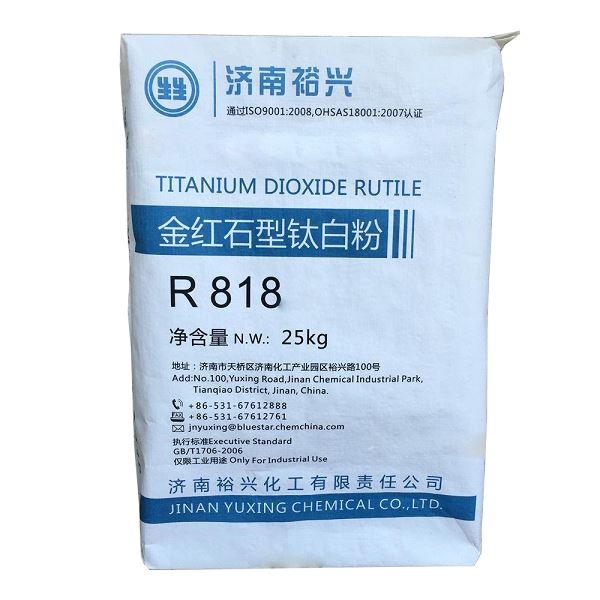
Titanium dioxide is divided into two types in terms of crystal form: rutile titanium dioxide and anatase titanium dioxide. At present, rutile titanium dioxide accounts for 75 to 80% of the world's consumption of titanium dioxide, and anatase titanium dioxide only accounts for 20 to 25%. Since they belong to the titanium dioxide series, what is the difference between these two kinds of titanium dioxide? Mainly the use performance determines the different uses.
Titanium dioxide has excellent pigment properties such as high decoloring power, high hiding power, high reflectivity, and low specific gravity. It is the best white pigment. The crystal lattice of rutile titanium dioxide is denser and more stable than that of anatase titanium dioxide. It has better weather resistance, water resistance, and is not easy to turn yellow and does not chalk, but the whiteness is slightly lower. It is suitable for outdoor use. pigment. Anatase titanium dioxide has a large lattice space, is relatively unstable, has poor weather resistance, is easy to yellow, and is easy to pulverize, but has high whiteness and is suitable for the manufacture of indoor pigments. Anatase titanium dioxide can be converted into rutile titanium dioxide at 915°C.
Titanium dioxide for rutile pigments is used to manufacture outdoor paints such as automotive paints, marine paints and alkyd enamels. Durable plastic products for external use also need rutile titanium dioxide to increase weather resistance. Rutile titanium dioxide is also used in the ink printing industry, and titanium dioxide for anatase pigments is used to make white and light-colored interior paints. Anatase titanium dioxide is also widely used as a colorant and filler in paper, rubber and plastic products. Titanium dioxide for chemical fibers is used as a matting agent in synthetic fibers, titanium dioxide for metallurgy is used to make titanium-containing high-temperature alloys, titanium dioxide for enamel is used as an opacifier in enamel, and titanium dioxide for welding electrodes is used as a coating in welding electrodes. Slag agent and plasticizer, and titanium dioxide for capacitors are the main raw materials for manufacturing wireless ceramic capacitors.
In recent years, with the expansion of high value-added applications of titanium dioxide, such as the production of color paper, medicine, cosmetics, food additives, catalysts or catalyst carriers, etc. Titanium dioxide has certain potential uses in the field of high-tech technology. For example, it can be used as a photochemical catalyst, color photosensitive material (using its photoelectrophoretic properties), bactericide, photodecomposition agent for water produced from seawater, conductive additives, and adsorbents. Wait.